
IT&C Consulting & Advisory
We sit at your table as an independent technical voice — and put our hands on the keyboard when needed — so that every leu invested in IT&C buys exactly what your company needs.
More details
Clients who have placed their trust in us







































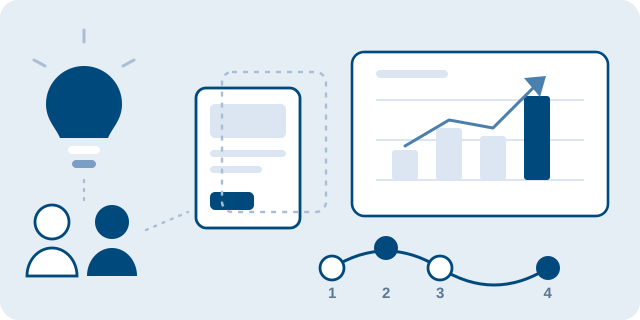
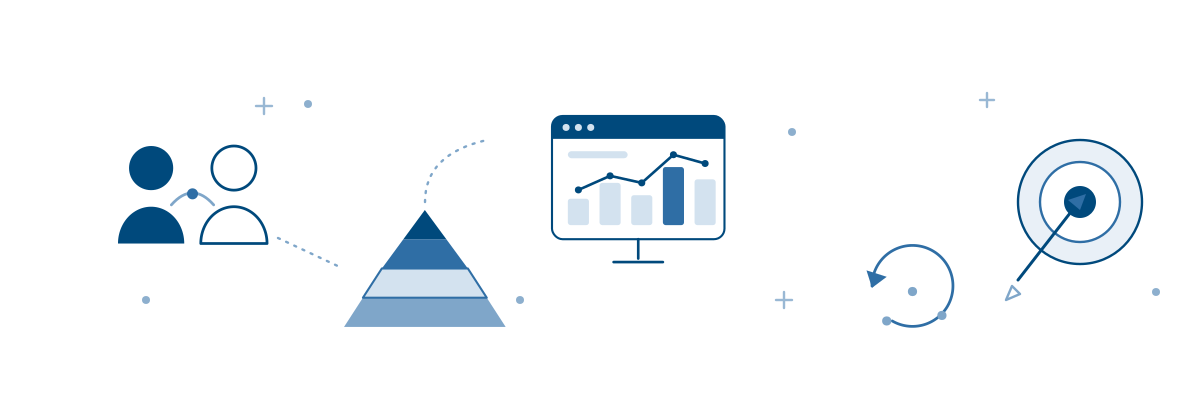
The services provided by Cronoxy form our own approach to analysis, discovery, design, implementation and continuous improvement — from clean data and independent advisory, through the operational level and the governance shield, up to strategy and innovation.
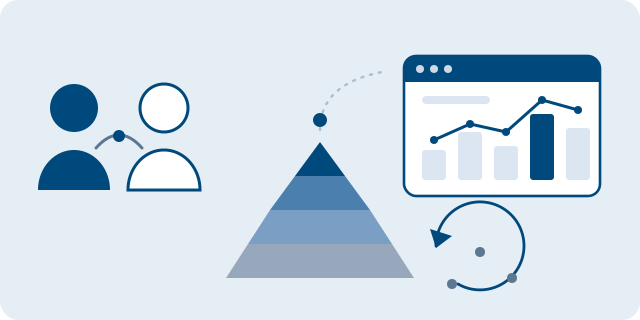
The governance pyramid arranges the organization into four layers: at the top, the strategic layer, where direction is set and overall results are owned — vision, profitability, market share. Below it, two bridges translate strategy into operations — one protects the organization (governance, risk, compliance), the other transforms it (innovation and efficiency) — and further down, at the base, sits day-to-day execution: process quality, procedures and customer satisfaction. At the foundation of the whole structure lie clean, unique data, without which everything built above becomes mere opinion.
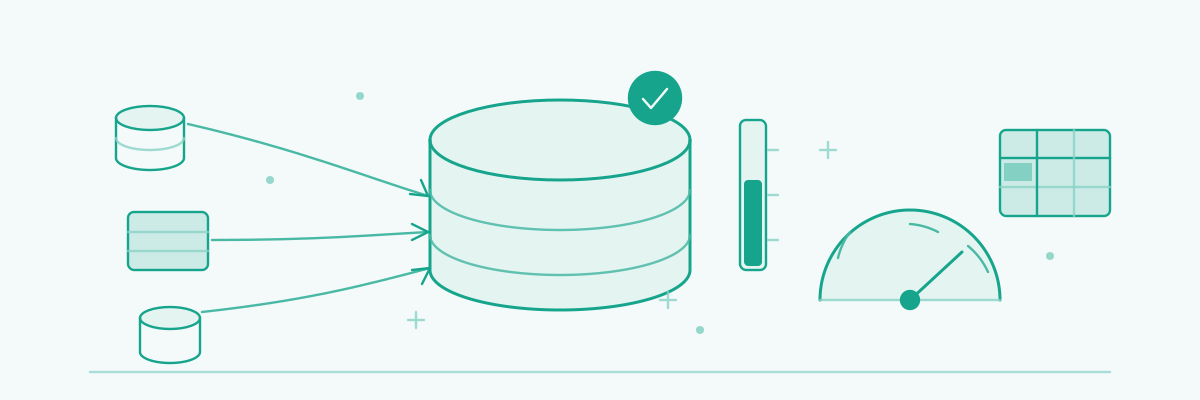
The foundation is the layer everything else rests on: your data and your advisory. First we make sure your data is correct, unique and owned by your company — a single source of truth, with a clear owner and measured quality. In parallel, we stand beside you as an independent technical voice that turns business goals into IT&C decisions and puts hands on the keyboard when needed. Without this layer, every system built on top inherits the same errors and the same ambiguities. With it, every decision above starts from a solid, verifiable base.
We sit at your table as an independent technical voice — and put our hands on the keyboard when needed — so that every leu invested in IT&C buys exactly what your company needs.
More detailsCorrect, unique data in your own possession, on your own platform: a single source of truth, an owner for every dataset and measured quality. The foundation every decision rests on.
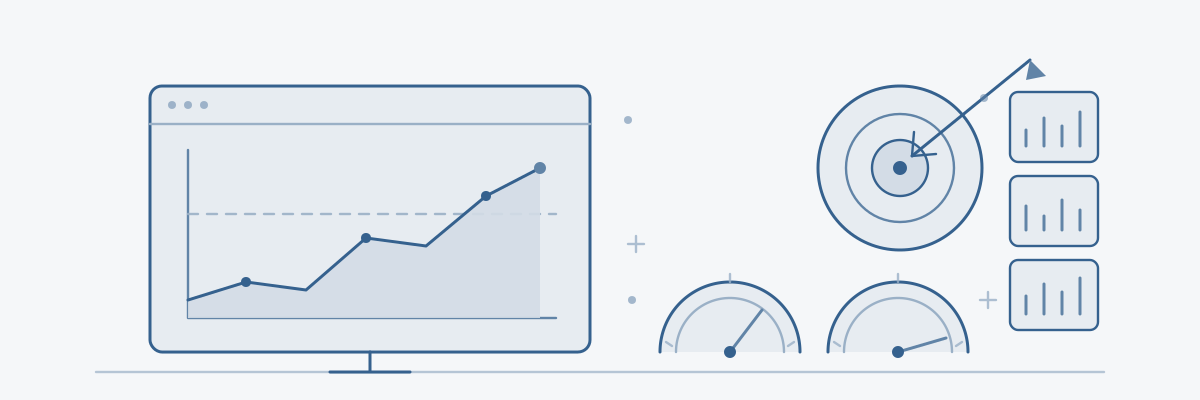
More detailsAt the top of the pyramid you set the direction and measure whether you reach it. We start from an objective digital-maturity assessment that shows where you stand against your market segment and which roadmap has the greatest impact. We then build a performance-management system, with indicators across levels and verticals, so results stay visible and comparable over time. And when a large-scale change is needed, we lead it through a complete digital-transformation methodology, from the decision to measured adoption. This is the layer that ties technology investment to the real goals of the business.
Where you stand on the 7 dimensions of digitization, how you compare with your market segment and the highest-impact roadmap — with a clear, objective maturity index you can base your decisions on.
More detailsComplete, continuous measurement: performance indicators across levels and verticals, plus behaviour indicators. OKR, CFR, Balanced Scorecard and the performance–behaviour matrix, with observable anchors — among other tools suited to your context.
More detailsThe full digital-transformation methodology: from the decision to buy or build a system and design it, through implementation, go-live and measured adoption — whoever builds it.
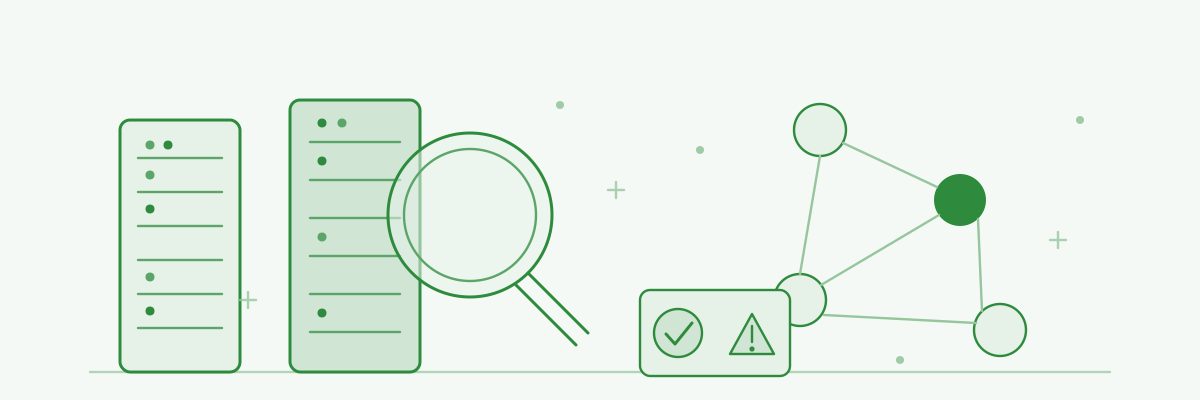
More detailsThis is the organization's shield: how decisions are made, the risks you take and the way you protect yourself. We assess the cybersecurity of your systems and find the vulnerabilities before anyone else does. We then put in place a framework for decision governance, risk and compliance, so every important decision has a process, an owner and an auditable trail. This protects your data, your operational continuity and your reputation alike. It is the layer that turns compliance from a burden into an advantage of trust.
We technically test your network, systems and applications, rank vulnerabilities by real business risk and close them in a verifiable remediation-and-retest loop.
More detailsThe framework in which the organization decides and protects itself: who decides what, on what evidence, a decision log, a living risk register and NIS2, GDPR and ISO compliance treated as risk management.
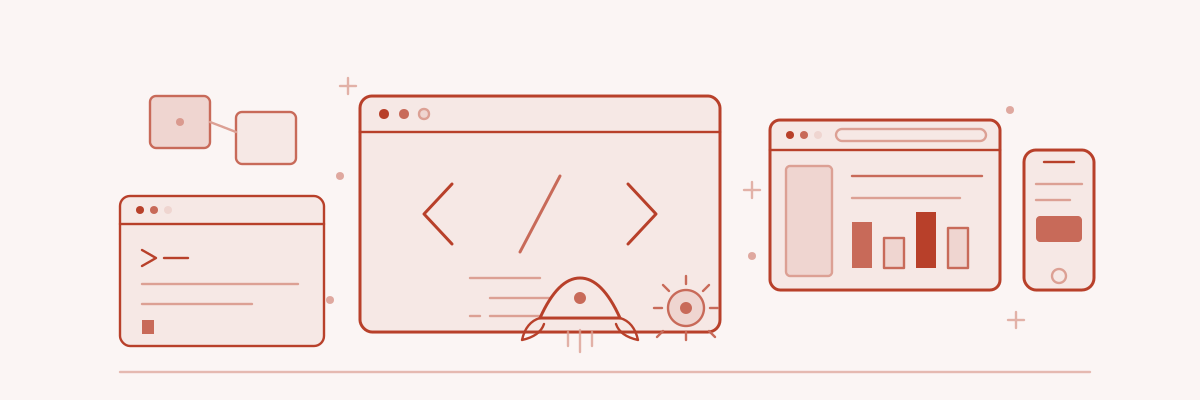
More detailsThe accelerator is the layer where you gain speed and margin, without waste. We analyze repetitive processes and make them more efficient through worthwhile automation (NoAUTO - Not Only Automation), with or without artificial intelligence (NoAI - Not Only AI) — we choose the technology only where it delivers a real return. When the market offers no fitting solution, we build one, with software tailored to your workflows. Every intervention starts from a clear business case, not from a trend. The result: less manual work, faster processes and tools that remain yours.
We assess the payoff before automating and decide separately whether the solution needs AI. Automation, semi-automation or AI agents — only where the return threshold is met.
More detailsWe develop the custom solution when the market offers no fit or integration needs full control — always tied to the right decision, never sold as hours.
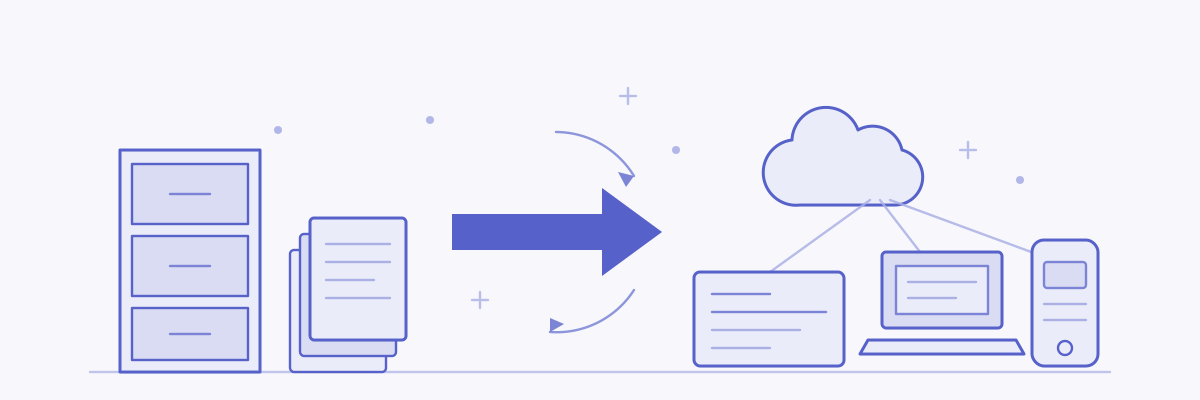
More detailsThe operational level is the company's day-to-day engine — where the work actually happens. First we check that your IT&C infrastructure is healthy, secure and sized correctly for what you do. We then standardize procedures and digitize document flows, so things happen the same way, correctly, no matter who carries them out. And we optimize the customer experience, so every interaction is consistent and easy. When this layer runs predictably, everything built on top becomes simpler and more cost-effective.
A complete map of your infrastructure and applications: inventory, topology, dependencies and real adoption. The map every later decision rests on.
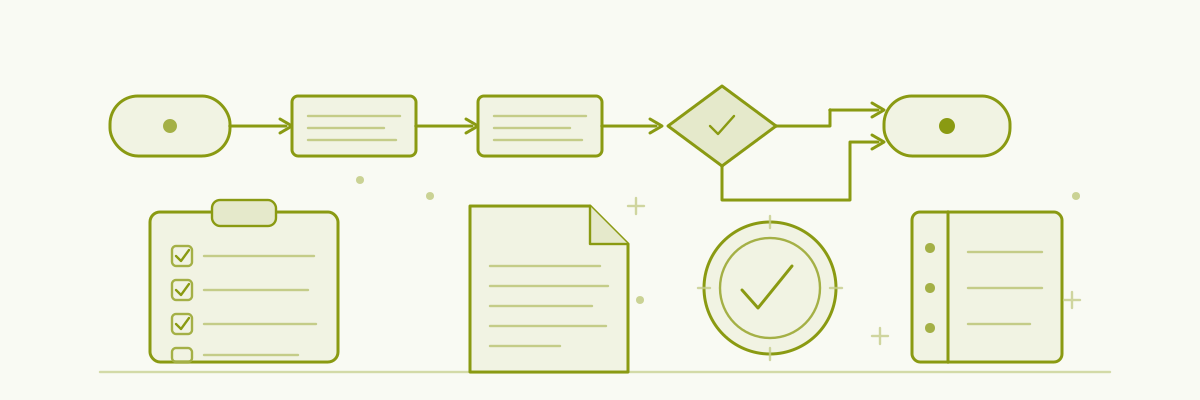
More detailsA living library of procedures and work instructions: one way of working, repeatable quality and the ground ready for automation. You can't improve what isn't stable.
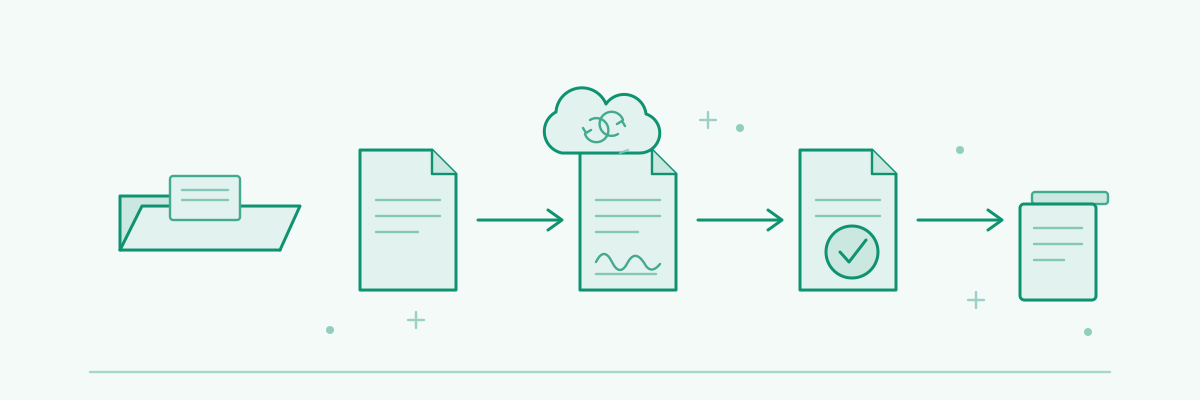
More detailsYour document circuit digitized: standardized templates, approval flows, versioning, archiving and full traceability. The most visible short-term result.
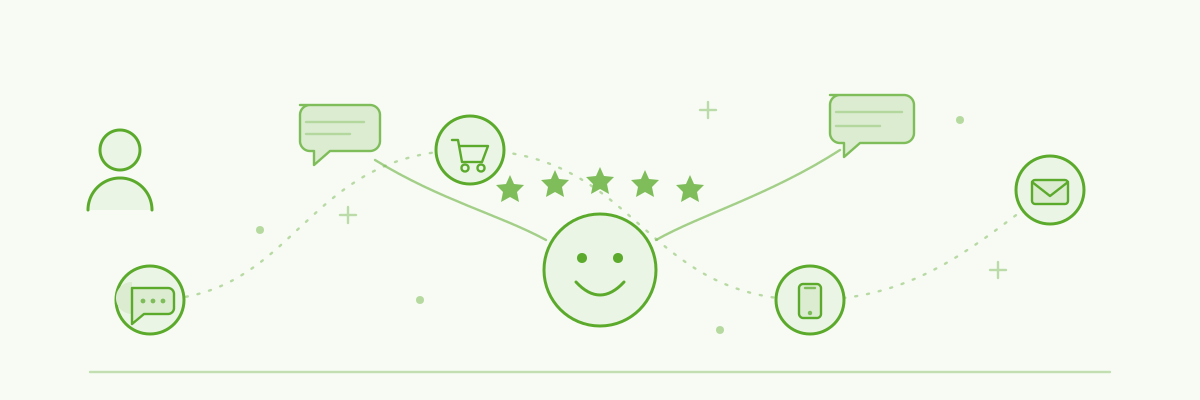
More detailsThe customer at the center: all channels in one shared space, marketing and sales data in a single decision system and personalized, timely communication based on real data.
More detailsThe seven action directions represent Cronoxy's perspective on your organization and, at the same time, a self-assessment grid for the business owner — the foundation from which the thirteen services we offer are derived. They cover, in the order of their existential importance, the customer and the market, financial health, risk and continuity, data, people and performance, procedures and, finally, efficiency applied with discernment. Each direction has its place on your organization's governance pyramid — some at the strategic level, others in operations, all resting on the foundation of data. Together, they form the operating system of your business — not the entire business, but the coherent framework in which each service finds its purpose.
Direction 1
We believe the customer belongs at the center of the organization — not only through their satisfaction, but through the entire value your company creates and delivers to them. That is why this line of action answers three questions at once: why people choose you, how you deliver value to them day by day, and where the next customers come from — not just how you retain the current ones.
We start from the strategic question: why do customers choose you over your competitors? The answer — your value proposition and positioning — sets the direction for everything that follows, so we clarify it together with you, based on a market and competitor analysis, and turn it into a coherent message, the same across all channels.
On that direction we build the day-to-day relationship. We start with a map of the customer experience — from first contact to renewal — and mark the points where you lose customers or time. We then bring every channel (e-mail, phone, WhatsApp, website forms, social media) into one shared workspace — our ClLink platform — so no request is lost and no one has to ask “who replied?” again. We centralize marketing and sales data into a single system — a CRM with each customer’s full history one click away — and set up personalized, continuous and timely communication that starts automatically at the right moment (offer, follow-up, renewal).
We put the same discipline in the service of growth, not just retention. We set up a sales pipeline with clear stages and owners, so you can see where new customers come from and where they get stuck, and we use it to help you enter new markets and offerings. And the value consistently delivered settles into reputation and brand — the asset, often unrecorded on the balance sheet, that makes you the chosen one next time; we track it from data (reviews, NPS, market signals), just like any other indicator.
In the end you are left with concrete things: the customer experience map, all channels unified in one workspace, a CRM populated with full history, a set of automated communications and a dashboard that measures satisfaction, retention and reputation. This way, the customer no longer sits “at the center” as a slogan, but as a way of working you see every day.
Direction 2
We believe your business’s financial health — liquidity, working capital, margin and cost structure — is actively steered, not merely reported at year-end. Most companies don’t fail for lack of accounting profit, but for lack of cash at the wrong moment; that is why we treat money as the organization’s circulatory system, with the same discipline of measurement and decision as any other line of action.
We’ll tell you one thing openly: this is our youngest line of action and, for now, the only one without a standalone service. We put it into practice along two paths that work together. The first is about measurement: we build the financial vertical of your dashboard — cash flow, margin per product or service, unit economics, cost structure — and a liquidity forecast that shows you the tight months in advance, before they catch you unprepared. The second is about decisions: we tie every investment or automation decision to real figures, not impressions, so you know not only “can we afford it?”, but “is it worth it and how soon does it pay off?”.
Concretely, you are left with: an up-to-date financial dashboard, a cash-flow forecast for 3–12 months, unit economics calculated on the main revenue lines, and a set of alerts — for instance, when projected receipts don’t cover payments due. Our aim is to turn this line of action into a dedicated service, with its own forecasting tool; until then we work with the instruments we already have for performance and for decision governance.
One thing we state clearly from the start: we can build the digital instrument that shows you the money in real time and warns you in time, but the capital decision — how much you invest, where you finance from, what risks you take on — remains yours. We give you the clear picture on which the decision is made.
Direction 3
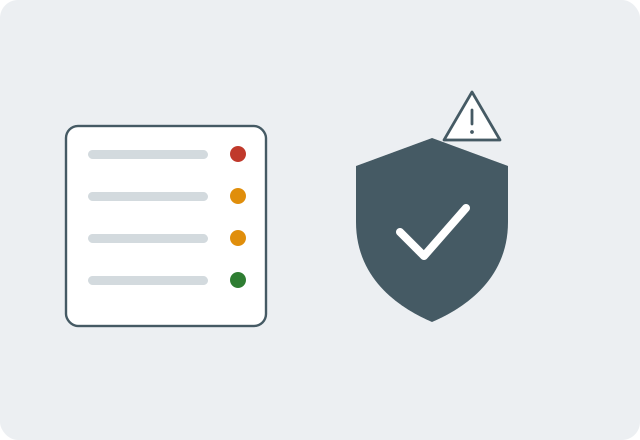
We believe in risk management and in decisions grounded in data. Every organization is permanently exposed to risks — operational, cybersecurity, compliance, financial, dependence on suppliers or on key people. The difference between companies is not the absence of risk, but the fact that risks are known, assessed, owned by someone specific and kept under watch. And decisions — on investment, automation, prioritization — are best made from a single source of truth, not from impressions or the opinion of the loudest person in the room.
We put this line of action into practice on two levels. On the technical level, we test your network, systems and applications and rank vulnerabilities by their real risk to the business, not by an abstract score; this also includes NIS2 readiness and the reporting deadlines to the authority (alert within 24 hours, notification within 72, final report within 30 days). On the governance level, we leave you with living instruments, not shelf binders: a risk register where each risk has a named owner, a probability and impact estimate, a treatment measure and a review deadline; a decision-rights matrix that says who decides what and up to which threshold; a compliance matrix (NIS2, GDPR, quality standards) tied to risks and owners, treated as risk management, not as box-ticking paperwork.
We treat the upside symmetrically: an opportunity you haven't assessed is also a risk — the cost of not having pursued it. And the register explicitly includes external dependencies — on suppliers, partners, channels — and internal ones — on key people and on you as the owner — accompanied by a continuity plan that answers a simple question: what do you do if tomorrow a system goes down or a person leaves?
Our differentiator is the decision journal: we record the decision made, its rationale, the alternatives rejected and who decided — so that six months later you can look back and learn from it. It is something almost no one offers in Romania's SME segment, and it is exactly what closes the loop: data → information → decision → action → measuring the effect. In the end you are left with: the technical security report, the living risk register, the decision-rights matrix, the compliance matrix, the decision journal and a clear review cadence — who reports and at what interval.
Direction 4
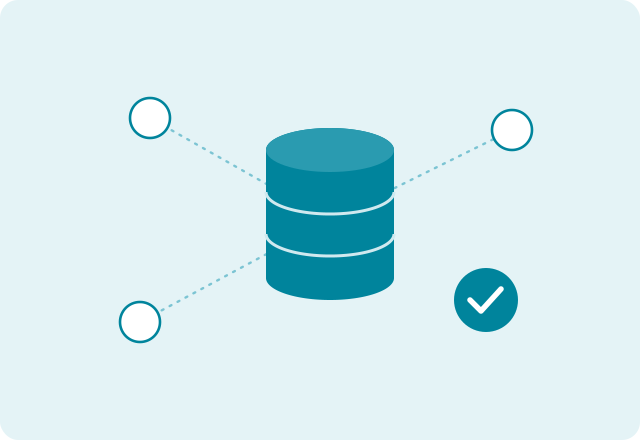
We believe that clean, unique data owned by you is the company's most valuable internal asset — its intellectual property and, at the same time, the organization's second brain: a memory that remembers everything the company knows. Data takes many forms: procedures, instructions, performance indicators, document templates, system-triggered events, alerts, notifications, requests from customers. Every other decision rests on it; without clean, unique data owned by you, everything built on top — reports, indicators, plans — is, in fact, mere opinion.
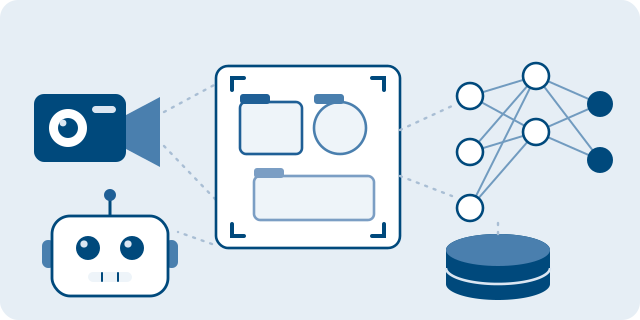
We put it into practice in two steps, with a third one at the entry. First we find out what data you have, where it is and how fragmented it is — often the same information lives in five places and none of them is “the truth”. Then we build a single source of truth: we assign an owner for each data set, set quality rules (what a correct record means), clean up duplicates and errors and move everything into a platform of your own — secure and synchronized almost in real time with what happens in the organization. If the right platform doesn't exist on the market, we build it; either way, the data remains your property, not a vendor's.
Only on such a clean foundation does the second brain come to life. On top of centralized, trustworthy data we place artificial intelligence, so you can ask your own organization in plain words — “which customers haven't ordered in three months?”, “which contracts expire this month?” — and get answers, not spreadsheets to leaf through. This is also our warning: placed over messy data, artificial intelligence gives answers that are confident but wrong — that is why the foundation comes first, and the AI after.
We also treat as an asset the intangible capital that data attests to — brand, reputation, trust, relationships — even if it doesn't appear on the balance sheet, and we measure it from the same data. In the end you are left with: a data catalog and dictionary, assigned owners for each set, quality rules measured periodically, source traceability for every figure and your own platform — the organization's second brain — on which all the other lines of action then rest. In practice, this is the foundation line of action: we place it first, because all the others stand on it.
Direction 5
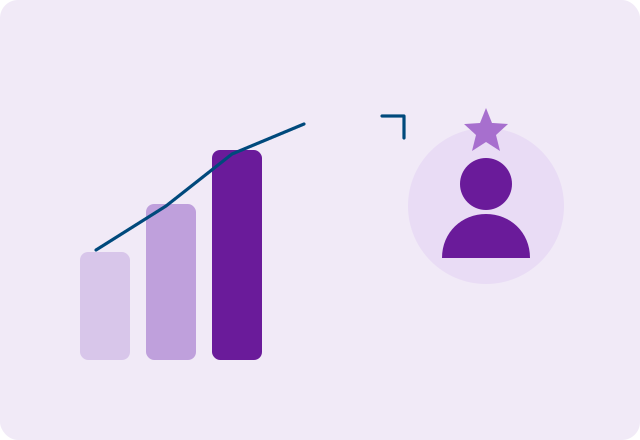
We believe in performance management through complete and continuous measurement — not to judge anyone, but so that you can grow. The first thing we clarify is that performance is measured first on the activity, not on the performer: a process delivers a result — at a certain throughput, cost, time and quality level — and those figures are the same regardless of who carries it out: a person, a non-AI automation or an AI agent. Only on top of this common layer do we add the “health” of each type of performer.
For people we measure two faces at once: performance (results, across levels — from team to organization — and across verticals, from finance to human resources) and behavior (leadership, adaptability, solving complex problems, emotional intelligence, alignment with the company's values, and so on). Behavior, however, we assess only through observable anchors — facts, not sympathies — otherwise the evaluation turns into a popularity contest. We bring these into a clear picture of each person and each team, kept alive through regular feedback conversations, not through a single form filled in once a year.
For non-AI automations and AI agents we apply the same discipline, treating them as a digital workforce: we track their reliability, accuracy, exception and escalation rate (how often they need a human's intervention), running cost and “drift” — degradation over time. We set thresholds, alert when they drop below them, retrain or adjust them and “retire” them if they no longer deliver. This way, the performance dashboard of the “digital employees” sits alongside that of the people — because, in a modern organization, work is no longer done by people alone.
This common, process-level measurement has a second purpose: it lets you compare like with like — the same process done by a person, by a non-AI automation or by AI, on the same figures — and it is exactly what makes the decision to automate or not an honest one (the link with the efficiency line of action). But measurement is only half of the line of action; the other half is what you do with it: growth plans, developing the competencies you lack, culture, leadership and a succession plan for critical roles, so that the business does not depend fragilely on two or three people. In the end you are left with: the set of objectives and key results, the performance dashboard (of people and of digital performers), the behavioral-anchor sheets, the picture of the team on the two axes and the development and succession plans. Dependence on key people we hand over as a managed risk, and the figures on the financial vertical directly feed the picture of the company's financial health.
Direction 6
We believe in the power of procedures and standardization as a way to raise the quality of your products and services. A library of procedures actually used — not kept in a drawer — permanently updated with reality on the ground and continuously improved, does two things at once: it raises your quality and makes it repeatable, regardless of who performs the work, and it prepares the ground for automation where it makes sense.
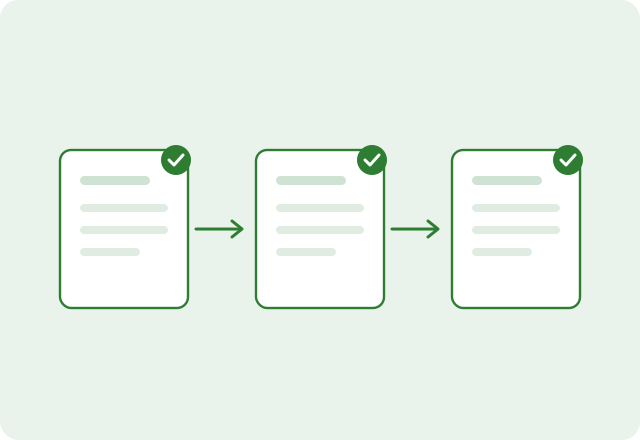
We put it into practice along two directions. First: we map your processes as they actually happen (not as they should on paper), mark the steps that produce errors or delays and build together a living library of procedures and work instructions — short, clear, used daily and kept up to date. Second: we digitize the document circuit through our Depunem platform — standardized templates, review and approval flows with clear steps and owners, versioning (you always know which is the latest version), archiving and full traceability of every document.
We strictly observe a rule of order: we do not automate what is not first stabilized — a chaotic process, automated, produces chaos faster. That is why standardization comes before automation. The documents part is usually the first visible win: it is delivered in a few weeks and is seen immediately on the desk. In the end you are left with: the process map, the library of procedures and work instructions, the digitized templates and approval flows, and the clean ground on which worthwhile automation can then be built.
Direction 7
We believe in the effectiveness and efficiency of activities: knowing which activities truly matter for your organization's objectives and what is the best way to carry them out. From this line of action follows our golden rule: we do not automate for the sake of technology and we do not put artificial intelligence everywhere just because it is fashionable.
In practice, we take each process that could be automated and calculate its return: how much the automation costs, how much you save and how soon it pays off. Only after the number works out do we automate — that is what “not only automation” (NoAUTO) means. Separately, we decide whether the solution really needs artificial intelligence or is solved more simply, cheaply and robustly without it — that is what “not only AI” (NoAI) means. And we always start from an already stabilized process: we don't automate chaos, we would put it in order first.
Where the numbers confirm it, we build both non-AI automations and AI agents that take over repetitive work, with a human in the loop where human judgment truly matters. In the end you are left with: a list of processes prioritized by return, the reasoned decision for each (automate or not, with or without AI), the solutions actually implemented and the measurement of the real gain after go-live — so you can see in black and white what each one brought. The name of this endeavor often draws attention through “AI”, but our promise is different: we automate only where it brings you a gain you can see.
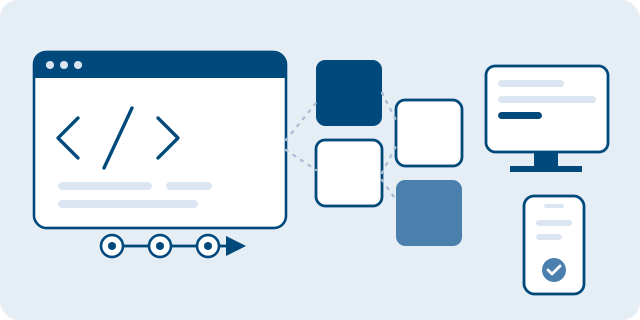
We combine deep technical expertise with a real understanding of your field to deliver software that lasts — adapting to your regulations, your data and your people, and keeping its value long after our solutions launch.
Talk to one of our experts PHP
PHP Laravel
 Python
 Node.js
 React
React Angular
 TypeScript
 .NET
.NET PostgreSQL
 MySQL
MySQL MongoDB
 Redis
Redis Docker
 Kubernetes
 AWS
AWS Google Cloud
 PyTorch
 TensorFlow
 LangChain
 Anthropic
 Elasticsearch
 Apache Kafka
 Grafana
 Git
Git