

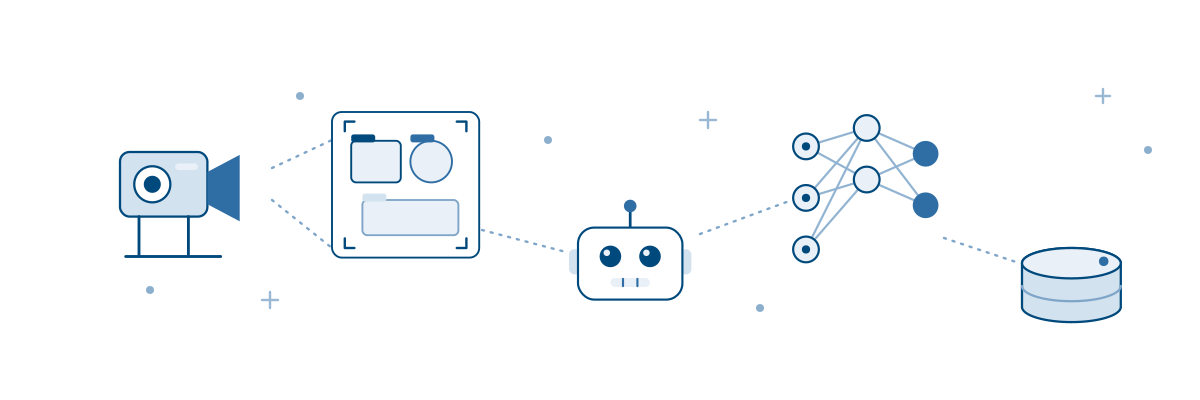
AI, Computer Vision & Agents

Talk to one of our experts
AI, Computer Vision & Agents

If you run into a different problem, don't hesitate to contact us and together we'll find the right solution

Get in touch with us

AI (Artificial Intelligence)

Artificial Intelligence (AI) is the most profound technological change in our lives and in those of modern organizations.

Intelligencethe ability to perceive a situation, to reason about it, to learn from experience and to choose the right action in order to reach a goal.

Artificialmade by people, not naturally occurring: obtained by design, from algorithms, data and computing power, instead of biological processes.

At the heart of this transformation are AI Agents — intelligent systems able to automate, optimize and transform business processes through continuous learning and adaptation to context.

Cronoxy provides complete services for designing, implementing and integrating AI agents into your organization's existing processes, so that it can realize the full potential of AI responsibly, ethically and efficiently.


AI vs. Human Intelligence

It is important to understand the relationship between AI and human intelligence:

AspectArtificial Intelligence (AI)Human Intelligence (HI)
BasisAlgorithms, statistical models, logical rulesBiological processes, evolution, emotions
StrengthsPrecise, consistent, efficient, scalableIntuitive, adaptable, creative, empathetic
LearningFrom data and patternsFrom experience and social context
LimitationsRequires large data volumes, lacks genuine intuitionBiological limits, cognitive bias
Optimal RoleAugmenting human capabilitiesOverseeing and guiding AI
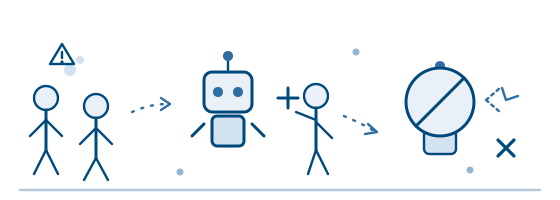
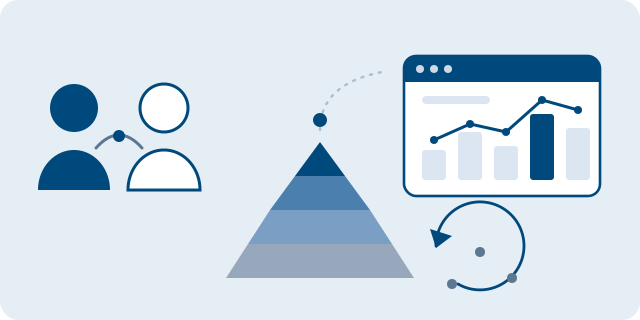
The "AI + Human Factor" approach

The most effective strategy is harmonious integration of AI with the human factor:

  • AI automates repetitive tasks and processes large volumes of data
  • People provide context, ethical judgement and creativity
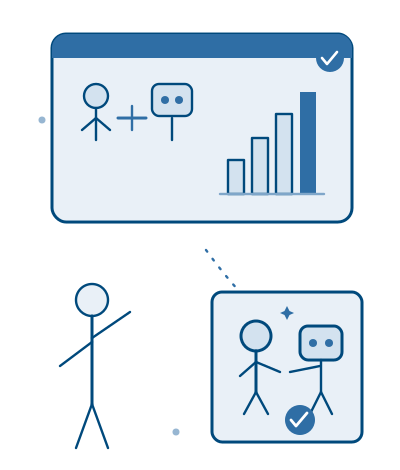
  • Human–AI collaboration produces better results than either approach alone
  • Human oversight keeps AI aligned with the organization's values

What is an AI agent?

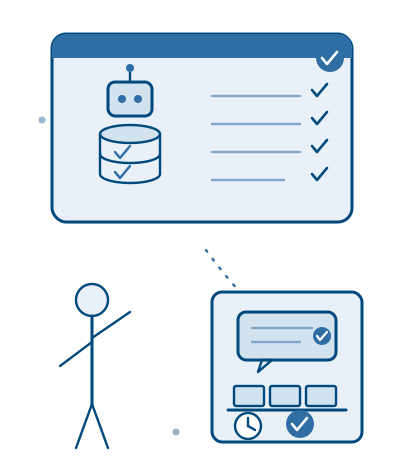
An AI agent can model and automate what people do: it is an intelligent software system that perceives its environment through sensors or data interfaces, reasons over the information it receives using algorithms and models, learns from experience and from the feedback it receives, acts autonomously to reach specific objectives and adapts continuously to changes in its environment.

The Data Foundation for AI Agents

Data is the essential fuel of any AI agent. Without quality data, AI agents cannot work effectively.

Why Data Quality Matters
  • "Garbage In, Garbage Out" — output quality depends directly on input quality
  • Poor-quality data leads to hallucinations (incorrect answers delivered with confidence)
  • Data must be clean, structured and relevant for the field of application
  • Data governance is essential to maintaining quality over the long term

Essential Characteristics of an AI System

1. Big Data Processing Capability
  • Processes massive amounts of data (structured and unstructured)
  • Analyses data from multiple and diverse sources
  • Extracts relevant information from vast volumes
  • Handles data efficiently in real time
2. Advanced Reasoning
  • Reasoning capability deductive (from the general to the particular)
  • Reasoning capability inductive (from the particular to the general)
  • Drawing logical conclusions from data and rules
  • Assessing probabilities and uncertainties
3. Continuous Learning
  • Learns from historical patterns
  • Improves through continuous feedback
  • Adapts its behaviour based on experience
  • Evolves together with the environment it operates in
4. Complex Problem Solving
  • Analyses complex, multi-dimensional problems
  • Identifies optimal solutions across vast possibility spaces
  • Applies creative strategies to new situations
  • Continuously refines its problem-solving approaches

AI Components and Domains

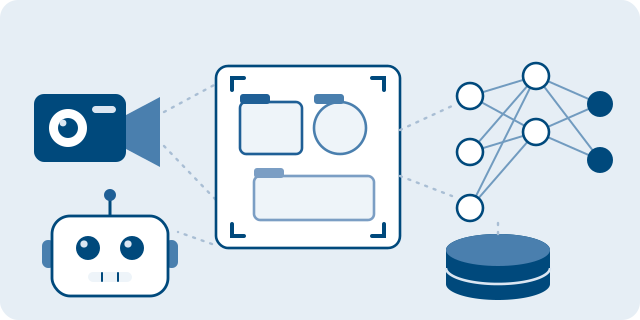
Computer Vision

the ability to "see" and interpret images and video

  • Reading scanned and photographed documents — invoices, delivery notes, forms and job sheets — turned into structured data.
  • Detecting and counting objects in a frame or a video stream: stock, packaging, vehicles, people.
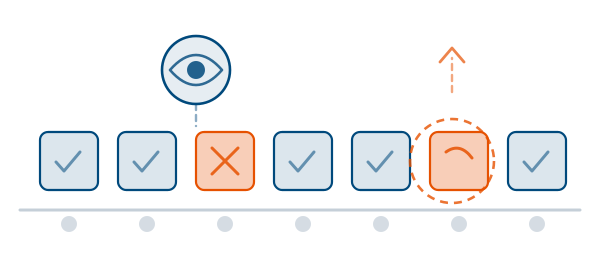
  • Visual quality control: spotting deviations from a reference before the product leaves for the customer.
  • Reading identification marks: serial numbers, batches, codes and licence plates.

It needs a usable image: stable lighting, consistent positioning and a reference set labelled by someone who knows the field.

Natural Language Processing (NLP)

the ability to understand and generate human language

  • Automatic classification and routing of requests arriving by e-mail, through a form or in chat.
  • Extracting information from unstructured text: clauses, deadlines, obligations and amounts in contracts.
  • Drafting replies, summaries and syntheses starting from the organization's own documents.
  • Semantic search: the answer is found by meaning, not by exact word matching.

Quality depends on the organization's internal language. A model that does not know your terminology answers convincingly, but wrongly.

Machine Learning (ML)

the ability to learn from data without explicit programming

  • Forecasts of demand, consumption and lead times, built on your own history.
  • Segments and scores: which customers, suppliers or orders need attention now.
  • Detecting deviations from the normal pattern before they turn into losses.
  • Price and cost estimates, calibrated on transactions already closed.

It needs a clean and sufficiently long history. Without one, the model learns the noise, not the pattern.

Deep Learning

deep neural networks for recognizing complex patterns

  • Recognizing patterns that human-written rules cannot describe: images, sound, free text.
  • Language models and vision-language models, which connect what is seen with what is written.
  • Successive layers that build the relevant features themselves, instead of receiving them ready-made.
  • Good results where data is plentiful, varied and hard to describe through rules.

Higher compute and data cost, lower explainability. It is justified where simpler methods have proven insufficient.

Robotics

the physical embodiment of artificial intelligence

  • Automated handling: picking, positioning, palletizing, feeding the line.
  • Autonomous navigation and internal transport, in the warehouse or on the shop floor.
  • Field inspection, where access is difficult or the operation repeats identically.
  • Human–robot collaboration on the same operation, with speed and force limits.

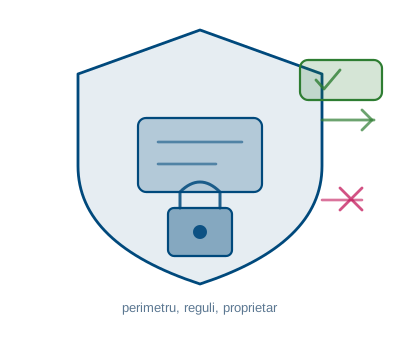
Here a mistake has physical consequences. The perimeter, the limits and the emergency stop are designed before the intelligence.

Expert Systems

applying domain knowledge to decision-making

  • Explicit rules, written together with the specialists who make the decision today.
  • Compliance and eligibility checks, with the decision path visible step by step.
  • Product configurators, quoting and pricing according to your own business rules.
  • Decision-tree diagnostics, where the answer has to be justified.

This is not outdated technology. When a decision must be explained and audited, a clear rule beats an opaque model — cheaper and more predictable.


What are the advantages of implementing and integrating an AI agent into existing processes?

Implementing AI agents in existing processes is a fundamental transformation that brings tangible, measurable benefits at every level of the organization. These advantages go beyond simple automation, offering genuinely transformative capabilities.

They accumulate in layers: first the operational gain, visible in hours and in the error rate; then the strategic one, in the quality of decisions and the speed of response; finally the technological one, in how systems integrate and adapt. They do not all appear at once and are not measured in the same way — some show in the first month, others only after the process has run steadily for a quarter. Below they are set out one by one, from the direct operational advantages to those that build up over the long term.

Direct Operational Advantages

Dramatic Operational Efficiency

Intelligent Automation:

  • Eliminating repetitive tasks that consume valuable employee time
  • Processing 24/7 without fatigue, errors or breaks
  • Simultaneous handling of hundreds or thousands of tasks in parallel
  • Cycle time reduced by 70–90% for many processes

Faster Processes:

  • Response times from hours/days to seconds/minutes
  • Real-time processing of requests and transactions
  • Removing bottlenecks and delays from workflows
  • Ability to respond instantly to change

Measurable Impact:

  • Studies show reductions of 40-60% in processing time
  • Throughput increases of 200-500%
  • Freeing up 30–50% of employee time for high-value work
Dramatic Cost Reduction

Operating Costs:

  • Reduction in labour costs for repetitive tasks
  • Eliminating overtime and the costs associated with shift work
  • Minimizing costly errors and the need for rework
  • Optimized use of resources

Scale Without Proportional Cost:

  • Handling increased volumes without proportional hiring
  • Horizontal scaling on demand
  • Marginal costs close to zero for additional volume

Demonstrable ROI:

  • Typical payback period: 6–18 months
  • Annual savings: 25–45% of the cost of automated processes
  • Return on investment of 300-500% over 3 years
Better Quality and Consistency

Eliminating Human Error:

  • Error rate reduced from 5–10% (human) to <0.1% (AI)
  • Perfect consistency in process execution
  • uniform application of rules and policies
  • Removing variability between operators

Standardization and Compliance:

  • Automatic documentation of every action
  • Full traceability for audits
  • guaranteed application of compliance controls
  • Reduced non-compliance risk
Better Customer Experience

Superior Service:

  • Availability 24/7 for customers
  • Response time instantly to simple questions
  • Personalization at individual scale
  • faster problem resolution

Satisfaction and Loyalty:

  • Satisfaction scores up by 25-40%
  • Waiting times down by 80-95%
  • Retention rates improved by 15-30%
  • A consistent, high-quality experience
Superior Scalability

Elastic Growth:

  • Instant adaptation to demand peaks
  • Ability to handle spikes of 10–100x in traffic
  • Without degrading performance or quality
  • Automatic scaling based on demand

Global Expansion:

  • Automatic multilingual support
  • Operating 24/7 across all geographies
  • Easy replication into new locations/markets
  • Global consistency with local adaptation

Strategic and Competitive Advantages

Better Accuracy and Insight

Improved Accuracy:

  • AI models trained properly exceed human accuracy
  • Identifying patterns that escape human observation
  • Predictions with 85–95%+ accuracy in many fields
  • Reducing human cognitive bias

Actionable Intelligence:

  • Real-time insight from complex data
  • Identifying opportunities and risks proactively
  • Recommendations based on comprehensive analysis
  • Simulation and predictive modelling
Data-Driven Decision Making

A Solid Basis:

  • Decisions based on analysis of complete data, not hunches
  • Eliminating of emotional or biased decisions
  • Validating options through simulation
  • Full documentation of the reasoning

Speed of Decision Making:

  • From weeks/days to hours/minutes
  • Capacity for rapid adaptation to change
  • Rapid testing and iteration
  • Feedback loops accelerated
Greater Transparency and Visibility

Real-Time Monitoring:

  • complete visibility over processes
  • Dashboards updated instantly
  • Proactive alerts for anomalies
  • Tracking end-to-end of workflows

Auditability and Governance:

  • Full traceability of AI decisions
  • Logging automatic, of every action
  • Easy demonstration of compliance
  • Analysis retrospective, for improvement
Innovation and Competitive Differentiation

New Capabilities:

  • Services impossible without AI
  • Personalization at a scale impossible by hand
  • Speed of increased innovation
  • Rapid launch of new products/services

Competitive Advantage:

  • Leadership technological, within the industry
  • Differentiation through superior capabilities
  • Attracting and retention of top talent
  • A brand as an innovative organization
Releasing Human Potential

Removing Tedious Work:

  • Employees are freed from repetitive, tedious tasks
  • Focus on work that is creative and strategic
  • Higher satisfaction at work
  • Reducing burnout

Augmented Capabilities:

  • Employees become more productive with AI as an assistant
  • Learning and accelerated development
  • Capacity to handle complex tasks
  • Human–AI collaboration for better results

What are the risks of implementing and integrating an AI agent badly into existing processes?

A flawed implementation of AI agents can have serious and costly consequences for an organization. Understanding these risks is essential to preventing them and to making the implementation succeed.

The Five "M"s of AI Risk

The image of "the quicksand of AI" describes a situation where an AI system, however well built it appears, rests on an unstable, insufficient or corrupted data foundation. Like a castle built on sand, the whole system can fail quickly, however sophisticated the technology.

1. Misadventure

Description:

  • Organizations "fall in love" with AI and use it as a universal solution
  • Leading with the tool (AI) instead of leading with a clear mission
  • Implementing AI to impress, not to solve real problems

Consequences:

  • Resources wasted on implementations with no clear purpose
  • Frustration across the organization and loss of credibility for AI
  • Public failures that damage reputation
  • Resistance increased, to future technology initiatives

Examples:

  • Deploying a sophisticated chatbot when the real problem is the onboarding process
  • Major investment in AI without understanding the business problems to be solved
  • "AI washing" — claiming to use AI for marketing purposes, with no real value

Critical Questions:

  • Why are we doing this? (not merely "what")
  • What is the opportunity cost of not implementing this properly?
  • Are the data and the organization ready?
  • Do we have the oversight and expertise required?
2. Misuse

Description:

  • Use of the wrong tool for the right problem
  • Training a model on a massive but irrelevant database
  • Applying AI in areas where brings no value

Consequences:

  • Poor performance and disappointing results
  • Costs high, without proportional benefit
  • Time lost instead of greater efficiency
  • Demoralization among teams and stakeholders

Examples:

  • Using a general-purpose LLM for specialized medical diagnosis
  • Applying conversational AI to processes that need only simple, structured actions
  • Using complex models where simple rules would be enough

Critical Questions:

  • What concrete problem does the chosen tool solve, and why this one in particular?
  • Would a simple rule solve the same problem, more cheaply and more predictably?
  • Is the data we train it on relevant to our field, not merely plentiful?
  • Who confirms the output is correct before it feeds into a decision?
3. Malice

Description:

  • Data Poisoning by bad actors
  • Manipulating training data to make the AI take wrong decisions
  • Cyber attacks specific to AI systems

Consequences:

  • Compromise of system integrity
  • Wrong decisions systematically
  • Financial losses significant
  • Reputational damage major
  • Legal liability

Examples:

  • Coordinated campaigns of disinformation to teach LLMs to spread false information
  • State actors that manipulate the data in order to influence the models
  • Injecting malicious data into training systems
  • Adversarial attacks that exploit weaknesses in the models

Critical Questions:

  • Who can change the training data, and what trace do they leave behind?
  • How do we detect an input crafted specifically to mislead the model?
  • What happens if an external data source is compromised?
  • How quickly can we stop the system and roll back to a clean version?
4. Missing

Description:

  • The phenomenon of under-representation in the training data
  • Data that do not represent the subject of interest well enough
  • Critical gaps in the data sets

Consequences:

  • Systematic bias against under-represented groups
  • Exclusion and unintended discrimination
  • Incorrect predictions for segments of the population
  • Legal problems and major ethical ones

Concrete Examples:

  • X-rays collected only from men → the computer fails to diagnose conditions correctly in women
  • COVID vaccination centres wrongly placed based on residence data instead of place of work
  • Facial recognition systems that perform poorly for certain ethnic groups
  • A a typing error in the data led to an erroneous AI report on the population of the state of Georgia

Critical Questions:

  • Which categories of cases are missing from our data, and who does that disadvantage?
  • How do we check that the set also covers rare situations, not only frequent ones?
  • How do we know that a missing record means "it did not happen", not "it was not recorded"?
  • Who is responsible for filling the gaps, once they are identified?
5. Moving

Description:

  • The real world changes continuously (the concept of drift)
  • Initial testing and training data quickly become irrelevant
  • Decision elasticity — how wrong a prediction can be and still lead to the same decision

Consequences:

  • Performance degradation over time
  • Hallucinations increasing as the world moves on
  • Decisions based on realities that no longer hold
  • The need for retraining constant

Examples:

  • The COVID-19 pandemic — existing AI models became almost useless because they were trained in a completely different world
  • Economic shifts rapid ones, which invalidate credit models
  • The evolution of language (slang, new expressions) that confuse NLP
  • Trends in consumption, changing faster than the data

Critical Questions:

  • How fast does the reality we are modelling change?
  • Which indicator tells us the model has started to degrade?
  • How often do we re-evaluate it, and who decides on retraining?
  • What do we do in the interval between degradation and correction?

Our Services

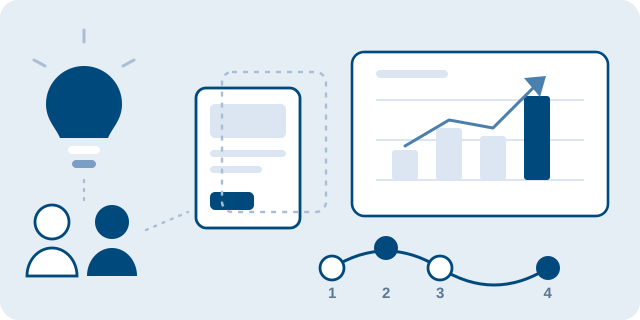
The services below cover the whole road, from the first question to a system running steadily.

You need not go through all of them, nor in order: we step in where it is useful to you. Some organizations need only the honest verdict of the first stage; others have their data in order and go straight to building. Each service can be contracted separately, with its own measurable outcome.

What they share is the NoAUTO and NoAI discipline: we do not automate and we do not add artificial intelligence except where the gain is visible in the numbers.

1. AI Strategy Consulting

We establish where artificial intelligence is worth it in your organization and, just as importantly, where it is not — before any investment.

  • Assessing the organization's readiness for artificial intelligence
  • Developing the strategy and the roadmap
  • Identifying and prioritizing use cases
  • Building the business case and estimating return on investment
2. Data Services

We prepare the foundation without which no model works: data that is clean, unique and governed.

  • Data audit and cleansing
  • Implementing a unified data platform
  • Data governance and compliance
  • Integrating data sources
3. AI Agent Development and Implementation

We build the agents themselves, on your organization's processes and knowledge.

  • Designing and developing custom agents
  • Answers grounded in the organization's own documents (RAG)
  • Multi-agent systems and their orchestration
4. Integration and MLOps

We connect the agents to the systems you already use and look after their lifecycle in production.

  • Integration with existing systems (ERP, CRM)
  • Automated delivery and deployment for models
  • Monitoring and observability in production
  • Model lifecycle management
5. Change Management and Training

We prepare the people who will use the system, because adoption, not technology, decides the outcome.

  • Change management strategies
  • Training programmes tailored to each role
  • Guidance and support in day-to-day use
  • Training internal change champions
6. AI Ethics, Security and Compliance

We check what can go wrong before it goes wrong, and leave behind rules, not merely recommendations.

  • Assessing the ethical implications of using artificial intelligence
  • Detecting and correcting bias
  • Regulatory compliance (GDPR, the EU Artificial Intelligence Act)
  • Governance frameworks for artificial intelligence
7. Continuous Optimization and Support

An agent left alone degrades quietly; we keep it in shape and re-evaluate it periodically.

  • Continuous monitoring and optimization
  • Retraining and model updates
  • Operational support
  • Continuous improvement

NoAUTO and NoAI: how we decide, before we build

NoAUTO stands for Not Only Automation: we assess the profitability of automation before applying it. NoAI stands for Not Only AI: the solution, automatic or semi-automatic, may or may not include artificial-intelligence models, following the same decision logic. We do not automate for the sake of technology and we do not add artificial intelligence because it is fashionable, but only where it brings you a real gain. Every candidate goes through five questions, in this order.

Is it worth it?

What the activity costs today, in hours and in errors, how often it repeats and how long the intervention takes to pay for itself. If it does not pay off, we stop here and tell you.

Is it stable?

An unstable process, once automated, produces the same chaos faster and at a larger scale. First we stabilize it, then we automate it.

Is the data there?

We check the foundation: clean, unique, complete and governed data. Without it, the system does not fail loudly — it answers convincingly and wrongly.

Does it really require AI?

Often a clear rule, a better form or an integration between two systems solves the problem more cheaply, more predictably and in a way that is easier to audit than a model. We choose the model only when the problem genuinely calls for it.

Who owns it?

We set the owner, what gets monitored, when it is reassessed and under what conditions it is stopped. A solution without an owner degrades, however well it was built.

The result of this discipline is a verdict on each candidate, including the verdict “not worth it, for now”. You receive it in writing, together with the figures it rests on, whether or not a project for us follows from it.

Together we build for you

Together we build for you.

Get in touch with one of our experts

The technologies we build with

Ubuntu ServerJava (OpenJDK)Node.jsNginxApacheBashLaravel ReverbDockerDocker ComposeKubernetesHelmAnsibleJenkinsGitGitLabPrometheusGrafanaNagiosSonarQubeKibanaLogstashPHPLaravelComposerFilamentLaravel SanctumEloquent ORMC#Visual StudioJavaScriptTypeScriptReactAngularjQueryD3.jsTailwind CSSHTML5CSS3VitenpmReact NativeExpofastlaneAndroidiOSSwiftXcodeAndroid StudioCocoaPodsGradleApache CordovaIonicFramework7Electronelectron-builderRedisRabbitMQApache KafkaPostgreSQLMySQLMariaDBOracleSQL ServerMongoDBElasticsearchCassandraCouchbaseHadoopMinIOApache IcebergParquetDuckDBPyIcebergpgvectorMilvusNeo4jOpenSearchpgAdminPythonC++LuaPyTorchTensorFlowKerasOpenCVLangChainHugging FaceOpenAIAnthropicAWSAzureGoogle CloudTwilioStripePayPalPestVitestJestPlaywrightMaestroCypress
@Cronoxy 2006 - 2026. Together we change the world.